Holss: The School That Changed Our Perspective on Education in Colombia
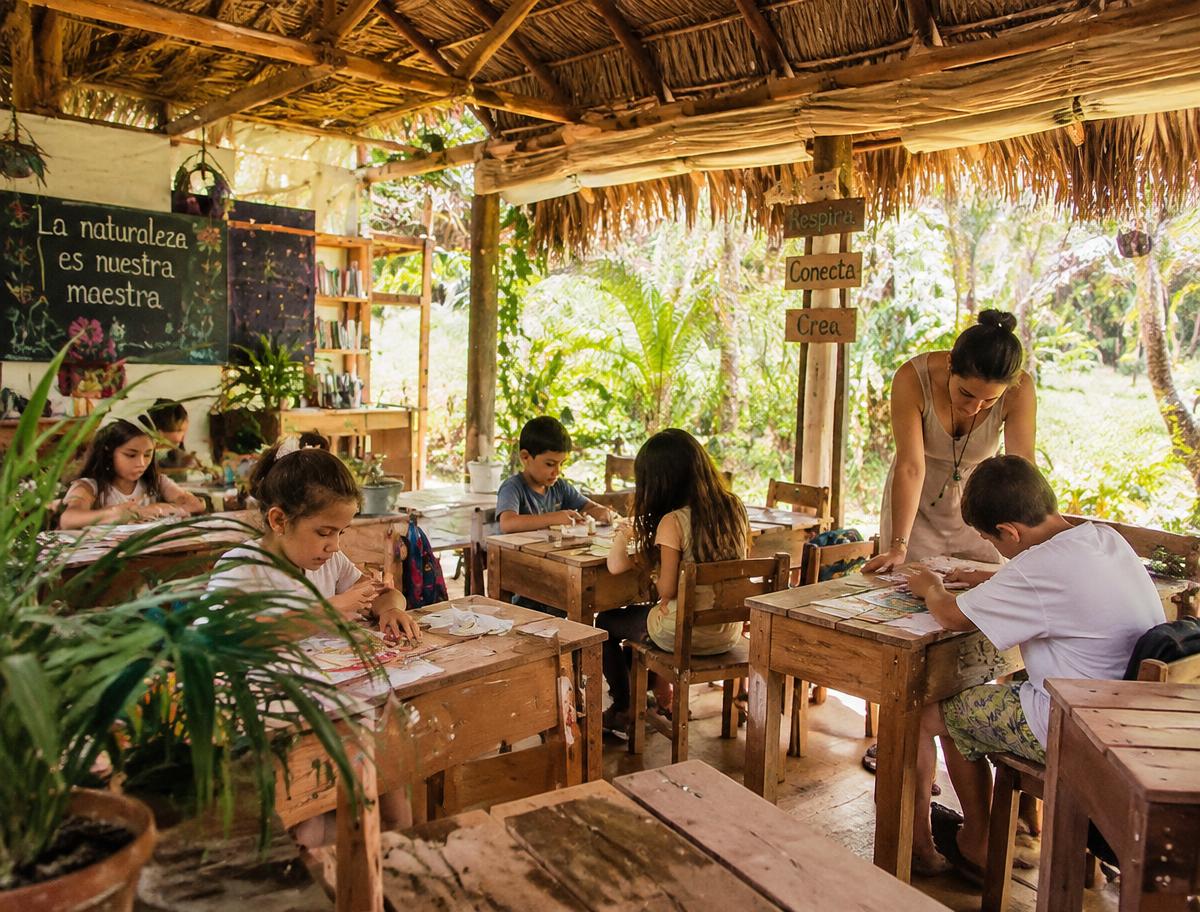
The First Day of School... and the Reality Check That Followed
After finally getting settled into our home over the weekend, we were relieved to hear that Monday was a holiday and there would be no school. That gave everyone a little more time to settle in before the girls started on Tuesday.
They were understandably nervous about their first day. New school, new teachers, new classmates, a completely different environment, and, of course, a language they didn't speak. It was a lot to take in.
Thankfully, the teachers were ready for them, and the other students were excited to meet them. The girls made it through those first four days the best they could, and we thought we were off to a pretty good start.
Then Monday came.
And boy, did all those emotions come pouring out!
Both girls started crying, refusing to go to school, and asking every question you could imagine: Why did they have to go to school in July? Why did they have to go when everything was in Spanish? How were they supposed to learn when they couldn't understand anyone? Why couldn't they just stay home?
We spent almost an hour trying to convince them to give it another week.
We explained that nobody expected them to be fluent in Spanish or excel academically right away. We weren't asking them to understand everything, make perfect grades, or become best friends with everyone immediately. All we wanted was for them to show up, try, stay open-minded, and give themselves time to adjust.
And, let's be honest, we may have needed a little extra motivation ourselves that morning.
Eventually, we struck a deal: if they went to school, we'd get them a snack afterward.
Sometimes parenting is about inspiring children to embrace new experiences. Sometimes it's about snacks. That day, it was definitely the snacks!
Looking back, I think that Monday was an important turning point. The girls were finally expressing how overwhelming the experience had been rather than trying to hold everything in. And we had to remind ourselves that adjusting to a completely different school system, culture, and language was going to take time.
So, What Exactly Is Holss?
Holss stands for Holistic School Society, and its story is one of the things that initially attracted us to it.
It was founded by a couple with school-aged children who struggled to find a school that aligned with their beliefs about education, curriculum, and the way children learn and develop. Rather than settle for something they weren't comfortable with, they decided to create their own school and build an environment around what they believed truly mattered for developing children.
The Holss approach focuses on five intelligences. Rather than looking at education exclusively through academic achievement, the school considers different dimensions of a child's development:
Cognitive Intelligence — How do I learn? Developing curiosity, critical thinking, problem-solving, and the ability to understand and process information.
Social Intelligence — How do I relate to others? Learning to communicate, collaborate, build relationships, and live and work with others.
Creative Intelligence — How do I adapt? Encouraging imagination, experimentation, flexibility, and the ability to find new ways of approaching challenges.
Emotional Intelligence — How do I understand myself? Developing self-awareness, confidence, resilience, and an understanding of emotions.
Physical Intelligence — How do I take care of myself? Building movement, coordination, physical awareness, and healthy habits.
This philosophy really resonated with us. We wanted our daughters to experience an education that went beyond textbooks, worksheets, and sitting at a desk for most of the day.
We wanted them to have opportunities to explore, create, move, socialize, make mistakes, develop independence, and discover what they enjoy.
And so far, we've been very impressed with what we've seen.
What Does a Typical School Day Look Like?
One thing we appreciate about Holss is that the school day isn't simply hours of sitting in a classroom.
The school day runs from 8:00 AM to 2:30 PM, with the daily classes changing depending on the cycle the students are in.
The general rhythm of the day is: morning classes, snack and recess, more classes, lunch and recess, then afternoon classes.
There is plenty of time built in for the children to get outside, eat, play, and interact with each other throughout the day.
The structure gives them a balance between focused learning and opportunities to move around and recharge, which we really like.
Understanding the Cycles and Age Groups
Holss organizes students into four cycles, with each stage having its own name and focus. Cycle 0 — Early Years covers Habitar (Pre-Kindergarten, ages 3.5–4), Imagine (Kindergarten, 4–5), Explore (Transition, 5–6), and Create (First, 6–7).
Cycle 1 covers Care (Second, 7–8), Living Together (Third, 8–9), and Communicate (Fourth, 9–10). Cycle 2 covers Transform (Fifth, 10–11), Experience (Sixth, 11–12), Go Deeper (Seventh, 12–13), and Cooperate (Eighth, 13–14). Cycle 3 covers Analyze (Ninth, 14–15), Specify (Tenth, 16–17), and Project (Eleventh, 17–18).
The names themselves reflect the school's philosophy. They're not just traditional grade labels; they describe different stages of a child's development and learning journey.
Spanish Immersion: Learning by Living It
One of our biggest questions before arriving was how the girls would manage attending a school where almost everything was taught in Spanish.
We knew this would be a challenge, but it was also one of the main reasons we chose Palomino in the first place. We wanted our daughters to have the opportunity to become comfortable with Spanish through everyday interaction rather than simply learning it from a textbook.
Some of the teachers spoke a little English to help the girls during the transition, which was incredibly helpful. However, with the exception of English class for Cycle 2, the rest of the classes are taught in Spanish.
That meant the girls had to learn to listen, observe, ask questions, pick up words, and gradually figure things out through context.
It hasn't always been easy, but one of the most beautiful things to watch has been how quickly children can find ways to communicate when they genuinely want to connect.
My youngest daughter, for example, has become best friends with another classmate who speaks only Spanish.
They play together and interact every day, and neither of them seems particularly concerned about the language difference. They just find a way to communicate!
Watching their friendship develop has been such a lovely reminder that connection doesn't always require perfect words. Sometimes a little imagination, playfulness, and a willingness to understand each other are enough.
The Teachers and the After-School Activities
One thing that stood out to us almost immediately was how kind and involved the teachers were. Every teacher we've met has been welcoming, patient, and genuinely engaged with the students. You can see that they care about the children and take an interest in their individual development.
Another thing we absolutely loved was the variety of after-school activities available. There were options like circus (including aerial silks), theatre, Spanish, cooking, knitting, sewing, and band and music.
The classes were generally around 20,000–30,000 Colombian pesos per class, depending on the activity.
Our girls jumped right into circus and cooking, and we also managed to convince them to try some one-on-one Spanish lessons.
These activities ended up being much more important than we initially realized.
During regular school hours, they were still navigating the language barrier and trying to understand their teachers and classmates. But after school, the activities gave them a more relaxed environment to play, experiment, and interact without feeling the same pressure to understand every word.
They could participate, have fun, make connections, and gradually become more comfortable around everyone.
It was wonderful watching their guard come down. Those friendships and experiences outside the classroom started making the school environment less intimidating, too.
We Are What We Eat: The Holss Food Philosophy
Another thing we found interesting about Holss is the importance it places on food and nutrition.
The school's philosophy is that food is much more than simply something to eat during the day. It's part of the learning environment, overall well-being, and sense of community.
The children share meals together, creating a daily ritual that encourages connection and belonging. The menu is designed around balanced nutrition, including proteins, carbohydrates, and fats to support their physical and cognitive development.
Holss also prioritizes low-glycemic foods to help maintain more stable energy levels throughout the day, with the goal of supporting concentration, motivation, and emotional regulation.
They avoid ultra-processed foods, refined flours, and excessive sugars, emphasizing more nourishing food choices instead.
I really appreciate this approach because it recognizes that what children eat can influence how they feel, their energy levels, and how ready they are to learn.
It's another example of how the school considers the whole child rather than treating academics as something separate from the rest of their environment.
And I love that something as simple as sitting down and sharing a meal is considered an important part of building community.
A Baby Turtle, a River, and a Very Different Kind of Field Trip
By our second month, the girls had already been on a few school outings, but there was one particular experience that made me laugh and reminded me that we were definitely not in the United States anymore.
One random late morning, my youngest daughter's teacher sent us a message. They had found a baby turtle on the school grounds and wanted our permission to take the children down to the river to release it!
I absolutely loved that.
Imagine getting a message from school asking whether your child can take a little walk to the river to release a baby turtle they found on campus.
It was such a simple thing, but it perfectly captured some of the things we had hoped to experience by moving abroad. Children being connected to their surroundings, interacting with nature, and learning through real-life experiences rather than everything happening inside a classroom.
Of course, we said yes!
It's these unexpected little moments that make this experience so special.
Open Holss: The Moment We Realized Just How Much Had Changed
Last month, the school held an event called Open Holss, where students showcase their work, projects, and what they've been learning to their parents and families.
By this point, the girls had only been attending Holss for about two and a half months.
We went in expecting to see a few projects, performances, and examples of what they had been working on. What we didn't expect was to be completely blown away.
Our eldest daughter got up on stage and performed, confidently demonstrating the aerial silks movements she had been learning. She also sang and played the bass on stage!
And then there was the moment that really got us: she stood at her science project station and explained her work to visitors... in Spanish!
Just two and a half months earlier, she had been crying because she couldn't understand anyone at school. Now she was confidently communicating with people in a language she was still learning.
Our youngest daughter surprised us just as much. She got up on stage, grabbed the microphone, and sang away with such ease and confidence. She also shared how much she had been learning in math, all in Spanish.
We honestly couldn't believe what we were watching.
Both girls had such incredible energy and confidence in everything they were doing. They weren't standing on the sidelines waiting for someone to tell them what to do. They were participating, expressing themselves, showing off their work, and enjoying the experience.
We were so proud of them.
What struck us most was that we hadn't really seen them get this involved or excited about school activities back home. Here, in a completely unfamiliar environment and learning in a language they didn't know when they arrived, they were discovering abilities and confidence we hadn't seen in quite the same way before.
It was one of those parenting moments when you step back and think, Wow. Look at what these kids can do when they're given the opportunity.
It's Not Always Perfect, and That's Okay
Of course, I don't want to paint a picture that everything has been perfect.
There are still days when one or both girls complain about school, struggle with the language, or have disagreements with classmates. Just like any school, there are good days and not-so-good days.
The language barrier is still a challenge, and adjusting to a new culture and learning environment doesn't happen overnight.
One thing we really appreciate, though, is the small class sizes. The average class has around five students, which allows for more individual attention and gives the children an opportunity to build closer relationships with their teachers and classmates.
And despite the occasional complaints, something reassuring has happened: they usually get over whatever bothered them and are ready to hop on their bikes the next morning to head to school and spend time with their friends afterward.
That, to us, is a pretty good sign that they're finding their place.
What's Next for the Girls?
The school experience has already opened up opportunities we never would have imagined before moving here.
Our eldest daughter has her first flight-based school field trip coming up this month! She'll be traveling to Medellín to visit Holss's other location in Rionegro for four days.
She's incredibly excited, and we're excited for her. The idea of our daughter getting on a plane for a school trip, traveling with her classmates, and experiencing another part of Colombia is something that would have seemed pretty extraordinary to us before this adventure began.
Winter break is also coming up soon. The girls will have six weeks off, and we're looking forward to doing some traveling, meeting up with family, and enjoying a little time away before returning for another round of school adventures.
Would We Choose This Experience Again?
Absolutely.
We went into this experience knowing there would be challenges. We knew the girls would be learning in Spanish, that the school would be different from what they were used to, and that all of us would have to adjust.
What we didn't know was how much they would grow in such a short amount of time.
Seeing them become more confident, participate in activities they might not have tried before, communicate in Spanish, and develop friendships has been incredibly rewarding.
More than anything, it's reminded us that education doesn't have to look one particular way. Children can learn through movement, creativity, nature, relationships, challenges, and experiences that take them beyond the classroom.
We're still early in this journey, and there is plenty more for all of us to learn. But we're grateful we took the leap and gave the girls this opportunity.
And if there's one thing those first few months have taught us, it's that sometimes the biggest growth happens right after the moment you're convinced you can't do something.
For our girls, that moment started with tears on a Monday morning... and turned into singing, performing, speaking Spanish, and standing proudly in front of an audience just a few months later.
We couldn't be prouder.
Interested in learning more about the school? Visit Holss — Holistic School Society to learn more about its educational philosophy and approach.